Re: Απ'το κόστος οδικών έργων, στο ευρώ, την Ε.Ε. και την δρ
Δημοσιεύτηκε: 15 Ιαν 2014, 21:25
Κάνεις λάθος ΚΑΙ τα υποκαταστήματα πρέπει να πληρώνουν φόρους εφόσον οι μαμα εταιρεία είναι εκτός ΕΕ.
Το site των οδηγών και των πεζών...
https://forum.odigein.com/
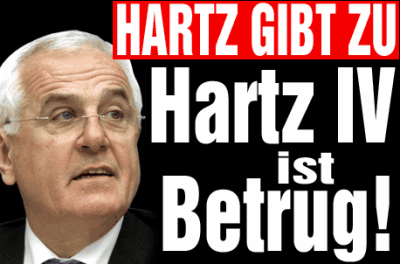
Μπορείς να μας πεις ποιος είναι ο Peter Hatrz και τι είδους μεταρρύθμιση έκανε στην γερμανική οικονομία για να την κάνει ανταγωνιστική; Τι ήταν η Agenda 2010 και γιατί έχασε ο Σρέντερ από την Μέρκελ το 2005;MacPap έγραψε:Ναι καλά κάνει αυτή η χώρα και επιμένει σε αυτά που επιμένει διότι αυτή η χώρα καταστράφηκε 2 φορές τον προηγούμενο αιώνα εντελώς και παρόλα αυτά ξανά κυβερνάει την Ευρώπη!!! Ε κάτι κάνει καλά! Αντί λοιπόν να την φθονούμε ίσως θα έπρεπε να ξεστραβωθούμε και να προσπαθήσουμε να της μοιάσουμε!!! Η Γερμανία και η κάθε Γερμανία δεν έγινε έτσι που που είναι σήμερα δια μαγείας ούτε χωρίς σκληρή δουλειά από τους πολίτες της!!! Αλλά αυτό τσούζει σαν ιδέα στους Ελληνάρες!

 )
)

απο: http://www.wsws.org/en/articles/2011/07/wage-j25.htmlFor many in Germany, the figures are shocking: Germany has a higher level of poverty than the Czech Republic - according to the latest figures released by the German Statistics Office.
The gap between rich and poor in Germany is steadily increasing. On Tuesday, the Frankfurter Rundschau newspaper reported that, in particular, low-paid workers have suffered a dramatic fall in income.
Those workers with so-called “mini-jobs” (marginal part-time employment), who in 2000 had a real net monthly income of €270 (US$380), received just €211 (US$303)—or nearly 22 percent less—last year. Those earning €835 net in 2000—for example, sales staff, assistant handicraft workers, employees in call centers and security services—made just €705, or 16 percent less, in 2010.
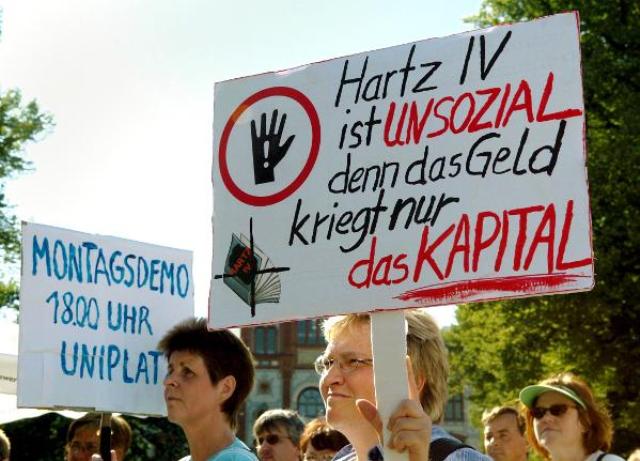
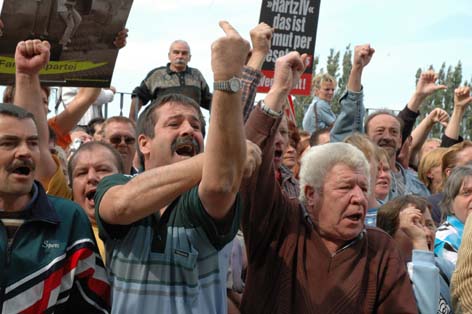
“The problem lies elsewhere”, writes Roth. Companies are often able to enforce extremely low salaries, “because the balance of power has shifted to the disadvantage of workers”. She refers to the genuine “fear of Hartz IV” unemployment payments, which ensures that workers are prepared to accept pay cuts and work in extremely low-paid “mini-jobs” earning a maximum of €400.[/b]
απο:Insight: The dark side of Germany's jobs miracleThe immediate effect was to leave those living on benefits worse off (as of 2013, the standard rate for a single person is €382 a month, plus the cost of "adequate housing" and healthcare). But the new element that brought the most profound change was the contract, drawn up between the "jobseeker" and the "Jobcenter", which defined what each party promised to do to get the jobseeker back on somebody's payroll. This was coupled with "sanctions" – in other words, benefit cuts – if the jobseeker failed to keep up his or her side of the bargain. With those two measures, Germany came to accept the modern interpretation of the word "incentive" in the job market: the doctrine that poor people will only work if they are they are not given money.
There are myriad debates about the net results or benefits of the Hartz reforms. Unemployment, both long-term and short-term, has certainly dropped considerably in Germany since 1 January 2003, but critics say that's only because most jobless people are forced to accept the next job they can find – and often they end up in one so low-paid and part-time that they were still dependent on some sort of state welfare anyway. Then again, the flexibility that allows employers – especially major industrial companies – to take on and lay off part-time shift workers depending on the state of the export market has certainly helped Germany to ride out the global economic crisis in the past three years.
But what is hard to overlook is that the Hartz reforms have had two social effects. First, they have helped to accelerate inequality in Germany. According to an April 2012 OECD report, "Germany is the only [EU] country that has seen an increase in labour earnings inequality from the mid 1990s to the end 2000s driven by increasing inequality in the bottom half of the distribution." The report goes on to point to "a set of reforms in 2003 meant to increase the flexibility of the labour market" which help to explain the "wage moderation".
Pay in Germany, which has no nationwide minimum wage, can go well below one euro an hour, especially in the former communist east German states.
"I've had some people earning as little as 55 cents per hour," said Peter Huefken, the head of Stralsund's job agency, the first of its kind to sue employers for paying too little.
As Heiner Flassbeck, a former German government official who is currently a director at the United Nations Conference on Trade and Development (UNCTAD) put it in an interview with Reuters in November, it is all down to "wage-cutting" and a "beggar-thy-neighbour export model," pursued by the "virtuous" nation led by Chancellor Angela Merkel.
"One country got it absolutely wrong," said Flassbeck. "That country was not Greece, it was Germany."
enias έγραψε:
...Το συμπέρασμα είναι οτι θα πρέπει να εξετάσουμε αν εμείς πρέπει να πάρουμε μαθήματα οικονομικών απο αυτούς ή αν αυτοί μας πρέπει να πάρουν μαθήματα πολιτισμού απο εμάς.
Αντι να προσπαθούμε να φτάσουμε εμείς την Γερμανία, θα μπορούσε να χαλαρώσει λίγο περισσότερο η Γερμανία και να ζήσουν οι δικοί της πολίτες της σαν άνθρωποι.